Introduction to Gate Valves
Gate valves are designed primarily for flow isolation rather than throttling. They are widely used in water, wastewater, gas, fire-protection and industrial systems for both above-ground and buried installation.
Gate valves are designed primarily to isolate fluid flow rather than regulate it. They are widely used across many applications and are suitable for both above-ground and buried installation.
How gate valves work
Gate valves belong to the family of multi-turn valves. The valve opens or closes fully as the gate moves up or down along the threaded stem. Gate valves are intended for fully open or fully closed service rather than throttling. They can be configured as clockwise-to-close (CTC) or clockwise-to-open (CTO), depending on the direction of stem rotation.
Gate valve applications
When fully open, a gate valve has very little obstruction in the flow path, resulting in minimal pressure loss. Gate valves are therefore commonly used where low head loss is required, and the straight-through design is well suited to pipeline-cleaning applications. Because the valve requires multiple turns to travel from open to closed, its relatively slow operation also helps reduce water-hammer effects.
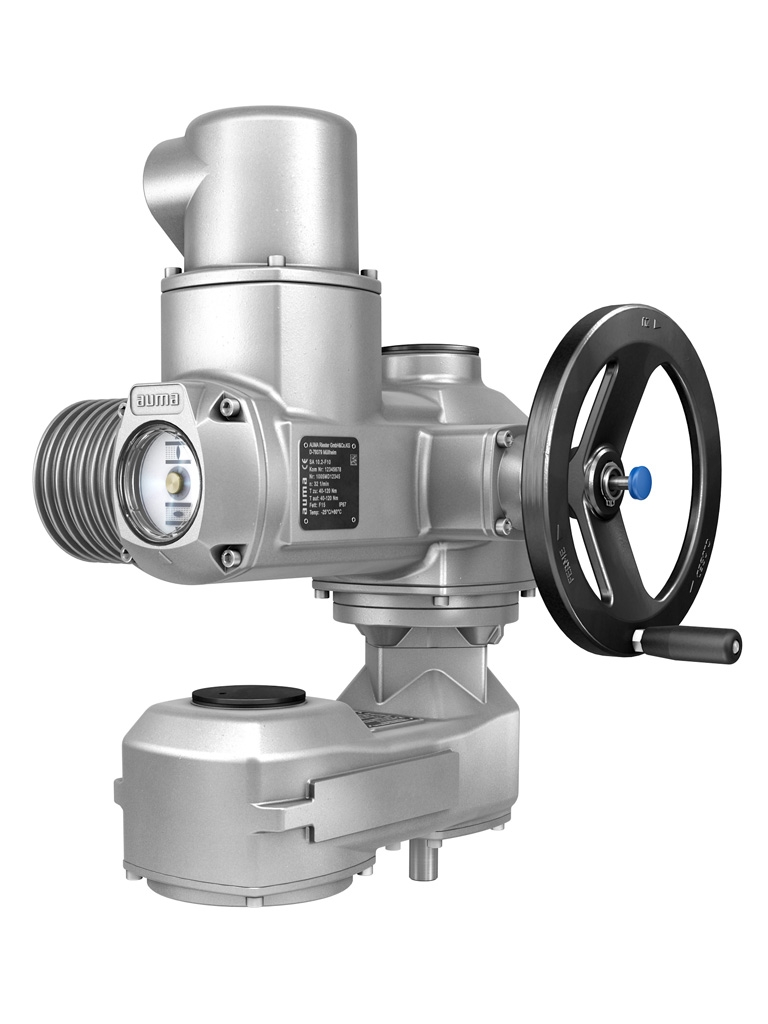
Depending on the application, gate valves can be operated by T-key, handwheel, gearbox or actuator.
Typical applications include water, wastewater, gas, fire protection and industrial systems.
Gate valves with bypass
A bypass arrangement is commonly used for three main reasons:
- To equalize differential pressure across the main valve, reducing required operating torque and allowing one person to operate the valve more easily.
- With the main valve closed and the bypass open, a limited flow can be maintained to help avoid stagnation.
- To allow a pipeline to be filled slowly.
Resilient-seated and metal-seated gate valves
Before resilient-seated gate valves became widely available, metal-seated gate valves were commonly used.
A resilient-seated gate valve has a straight-through bore that allows sand, gravel and other impurities to pass through the valve. If impurities are present when the valve closes, the high-quality rubber coating can deform around them. When the valve is reopened, the impurities are flushed away and the rubber returns to its original shape, supporting tight shut-off.
Metal-seated gate valves use a wedge-shaped gate and recessed sealing area at the bottom of the valve to achieve shut-off. Sand, gravel and debris can accumulate in this recess. Since a pipeline can never be completely free from impurities, even after flushing during installation or repair, a metal-seated gate valve can gradually lose its ability to provide complete sealing over time.
Rising-stem and non-rising-stem designs
In a rising-stem design, the stem is fixed to the gate and moves up and down as the valve is operated, providing a clear visual indication of valve position. The exposed stem is typically lubricated, while a rotating nut engages the stem thread and moves the stem. This design is suitable for above-ground installation.
In a non-rising-stem design, the stem thread is located inside the gate. Rotation of the stem raises or lowers the gate within the valve body while the stem itself remains in place, requiring less vertical installation space. AVK can provide position indicators fitted to the top of the stem. Non-rising-stem gate valves are suitable for both above-ground and buried installation.
Most AVK gate valve ranges use a non-rising-stem design, while rising-stem gate valves are also available for water, wastewater and fire-protection applications.
Wedge and parallel gate designs
Gate valves can be divided into two main design types: parallel and wedge. A parallel gate valve uses a flat gate between two parallel seats; a common example is the knife gate valve, which has a sharp lower edge on the gate. A wedge gate valve uses two inclined seats matched by a slightly tapered gate.
Most AVK gate valves use a solid wedge design. AVK also offers knife gate valves for wastewater treatment and parallel gate valves for gas applications.